AI Overviews One Year On: What Actually Happened to Click-Through
By Implai editorial · Aug 19, 2026 · ~5 min read · Updated Aug 25, 2026
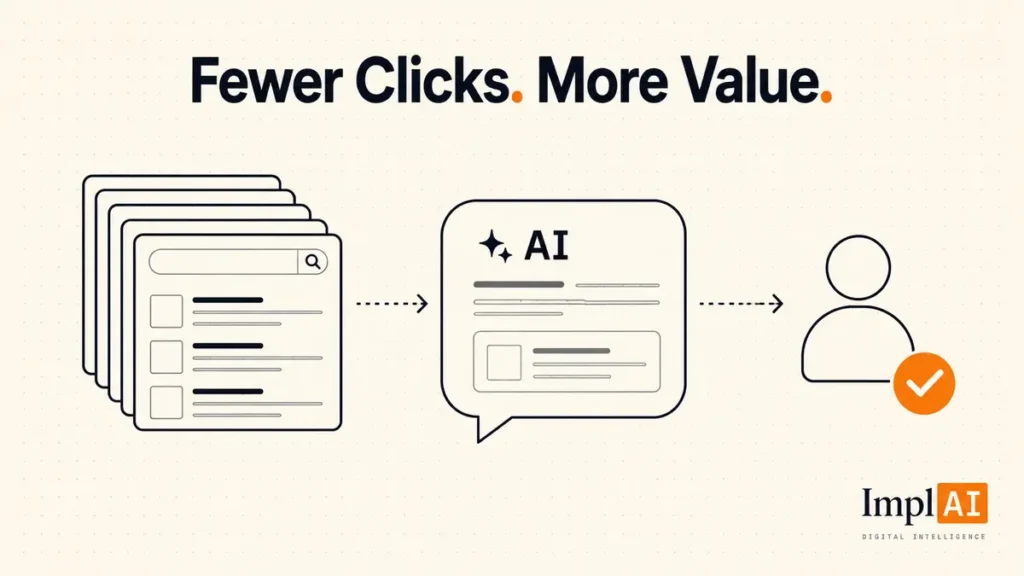
The honest version of "what happened to CTR" is messier and more interesting than either "AI Overviews killed search" or "nothing really changed." The most rigorously tracked longitudinal dataset available shows organic click-through on AI-Overview queries falling sharply through 2025, appearing to bottom out around the end of the year, then recovering significantly in early 2026 — though still well below pre-AI-Overview levels. Studies disagree wildly on the exact size of the decline (estimates range from roughly 15% to 89% depending on methodology and query type), which is itself worth knowing before trusting any single dramatic number. What the click-volume numbers alone miss: fewer clicks doesn't mean less value — traffic that does come through AI-driven surfaces tends to convert well, and by one direct account, converts best specifically at the final decision stage, not as a top-of-funnel discovery channel.
What actually happened to click-through rates over the past year?
The clearest picture comes from Seer Interactive’s ongoing tracking study — the same 3,100+ query, 42-organization dataset followed consistently from June 2024 through early 2026, rather than a series of unrelated one-off snapshots. The arc it shows is a real story with real movement, not a flat decline:
- Mid-2024 to September 2025: organic click-through on queries showing an AI Overview fell from roughly 1.76% to 0.61% — a steep, sustained decline over more than a year.
- Around the end of 2025: the decline appears to have bottomed out.
- By February 2026: organic CTR on those same queries had climbed back to roughly 2.4% — a significant recovery in a short window, though this is a rebound off the deepest point, not a return to pre-AI-Overview levels.
Seer’s own read on their data is worth taking seriously precisely because it resists a tidy conclusion: the relationship between AI Overview presence and organic performance is “more dynamic than a straight-line model,” and the firm’s own advice is that aggregate industry benchmarks can mislead — a business’s own data is the more reliable strategic input than any single published percentage, including the ones in this piece.
Why do different studies report such wildly different numbers?
Because they’re not measuring the same thing, even when the headline claims sound similar. Reported declines in organic CTR from AI Overview presence range from roughly 15% up to nearly 90%, depending on which study is cited — the specific figure moves with the query type studied, the time window measured, and the underlying methodology (crawled Search Console data versus a controlled behavioral study versus a single-month snapshot).
The direction is genuinely unanimous — every study measuring this finds a decline when an AI Overview is present. The magnitude isn’t, and treating any one dramatic number as settled fact is exactly the trap the aggregate-benchmark warning above is pointing at. A longitudinal, consistently-measured dataset like Seer’s is worth more than a bigger single number from a different study, because it’s tracking the same thing over time rather than comparing incompatible snapshots.
Does a lower click-through rate mean AI-driven traffic is worth less?
No — and this is the part that gets lost when the conversation stays fixed on click volume alone. Independent research on this exact question found that traffic referred from AI platforms converts at meaningfully higher rates than traditional search traffic, even though it’s a much smaller share of total visits (covered in more depth in Implai’s AEO/GEO/SEO explainer). Fewer visitors, but visitors closer to an actual decision.
That pattern isn’t just showing up in published research — it matches direct observation, independently. In our own work, we’ve seen the same shape: getting cited in an AI Overview or referenced by an LLM does sometimes reduce raw click volume on a given query, but the visitors who do click through convert at a noticeably high rate. Two separate sources landing on the same conclusion is a stronger signal than either one alone.
Where does AI-driven traffic actually fit into a marketing strategy?
As a complement, not a replacement — and specifically, based on direct observation, one that tends to perform best at the final decision stage rather than as a top-of-funnel discovery channel. Being cited in an AI Overview or an LLM’s answer doesn’t substitute for SEO, social media marketing, or any other channel; it adds a surface on top of them. Where it’s added real, specific value in practice is the point closest to an actual conversion — placing an order, completing a purchase, starting a subscription — rather than the earlier, broader “just researching options” stage a typical SEO click might represent.
Worth being direct about the limits of this specific claim: this is a real, repeated pattern from direct work, not a number from a controlled study, and it’s genuinely too early — with too little data collected on these newer traffic and conversion channels — to attach a specific percentage to it responsibly. Anyone claiming precise figures for AI-citation conversion rates this early in the channel’s life is likely overstating their own certainty, not just Implai’s.

What should this actually change about how a business tracks performance?
Less panic about a single click-through number, more attention to what happens after the click. If AI Overviews are pulling raw CTR down on some queries — which, per the research above, they demonstrably are, at least for now — the more useful question isn’t “how do we get the click-through rate back,” it’s “what’s actually happening to conversions once the smaller number of visitors arrive.” A channel that sends fewer people who are more likely to buy isn’t a channel in decline; it’s a channel that changed shape.
What’s next
The click-through numbers tell part of the story, but they’re the easiest part to measure and the easiest to misread in isolation — what happens after someone does click is where the more useful signal actually lives.
Frequently asked questions
Did AI Overviews really cut click-through rates?
Yes, consistently, across every study that's measured it — though the exact size of the drop varies enormously by study, query type, and measurement window, from roughly 15% to nearly 90% depending on which one is cited.
Has click-through rate recovered at all since the initial drop?
The most rigorously tracked dataset available shows a real recovery starting around early 2026 — organic CTR on AI-Overview queries climbing significantly off its lowest point, though still well below pre-AI-Overview levels.
If clicks are down, is AI-driven traffic still worth pursuing?
Yes — independent research and direct observation both point the same way: traffic referred from AI platforms converts at meaningfully higher rates than typical search traffic, even though there's less of it.
Does getting cited by AI replace the need for SEO?
No. It's a complement, not a substitute — it adds a discovery and citation surface on top of existing SEO, social, and other marketing channels rather than replacing any of them.
At what stage of the customer journey does AI-referred traffic perform best?
Based on direct observation, closest to the actual decision — completing a purchase, starting a subscription, placing an order — more than as a top-of-funnel discovery channel, though it's still early enough that this shouldn't be treated as a settled, universal number.